

The evolution of larger brains in humans and other closely related primates is often attributed to an expansion of the brain’s frontal lobe — the portion responsible for higher-order thinking, self-control, and other traits that enabled our species’ technological and artistic advancements. However, a new study from a researcher at The University of Texas at Austin suggests that it was instead portions of the brain that process visual information that drove this increase in brain size.
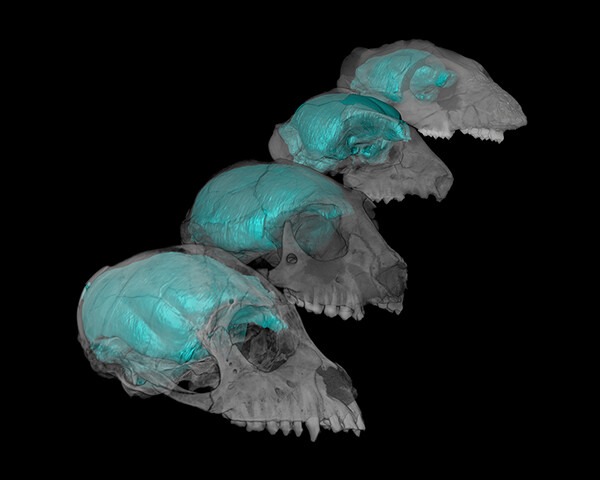
Many primates have larger brains for their body size relative to other mammals, with humans and closely related species of monkeys and apes having particularly large cerebral cortices (the folded, outer layer of the brain). In a new paper published in Science, a collaborative research team from UT-Austin and other institutions compared virtual endocasts from fossil and extant primate species to understand how and when these proportions evolved. Endocasts are 3D models of the inside of a skull that can be used to visualize the anatomy of the brain, allowing researchers to estimate both overall brain size and the relative size of different parts of the cerebral cortex.
In comparing endocasts from various species, the team concluded that the persistent assumption that large brains evolved in primates through the expansion of the frontal lobe was incorrect.
“It turns out that all primates, living and fossil, basically have the frontal lobe size that’s expected for their brain size,” says Chris Kirk, professor of anthropology at UT Austin and coauthor of the study. “Species with big frontal lobes, like humans, have them simply because they have big brains overall.”
In species of primates that evolved larger cerebral cortices, anthropoids (which include humans) and tarsiers (a small, tree-dwelling genus with notably large eyes), the team notes that increases in several parts of the brain that process visual information — the occipital, temporal, and parietal lobes — drove the expansion. But, says Kirk, because “a rising tide lifts all boats” this expansion of visual areas in the cerebral cortex is closely tied to expansion of the brain overall. These findings reveal that while humans and their close relatives do have large frontal lobes, which helps to account for their enhanced capacity for planning and strategizing, their frontal lobes aren’t disproportionately large.
Expansion of the parts of the cortex involved in visual processing occurred fairly early in primate evolution. The authors show that the pattern of larger occipital, temporal, and parietal lobes was already established by at least 33 million years ago in early fossil relatives of monkeys, apes, and humans. In addition to these changes in brain anatomy, they noted that fossil anthropoids show a simultaneous expansion in the size of the optic foramen, a hole in the eye socket through which the optic nerve transmits visual information to the brain. This coordinated increase in non-frontal cortex and optic foramen size supports the idea that increased visual input drove the increase in brain size.
“This link between expansion of the cortex and improvements in visual abilities really speaks to the fundamental adaptations of anthropoid primates,” says Kirk. “In humans and our close primate relatives, enhanced visual abilities are necessary for a range of cognitively demanding tasks, like recognizing the emotional states of other individuals based on their facial expressions. This dependence on vision is part and parcel of who we are and is also an important way in which we differ from other types of mammals, like rodents or bats.”