
A new UT Austin study suggests a link between psychological characteristics and environmental features.
Where you live shapes your daily routines and lifestyle in obvious ways. Someone who lives in an apartment next to a high-traffic street is likely to experience more noise and traffic-related stress than someone who lives on a rural ranch, for example. But over the past few decades, the field of geopsychology and its growing body of research have made a larger argument: that where we live might be measurably correlated with our personalities.
But to what degree can a neighborhood’s built environment — its building styles, greenery, sidewalks, even the flags on its porches — influence something as fundamental as personality? A new study published in the Annals of the American Association of Geographers indicates that the effects are real, and measurable.
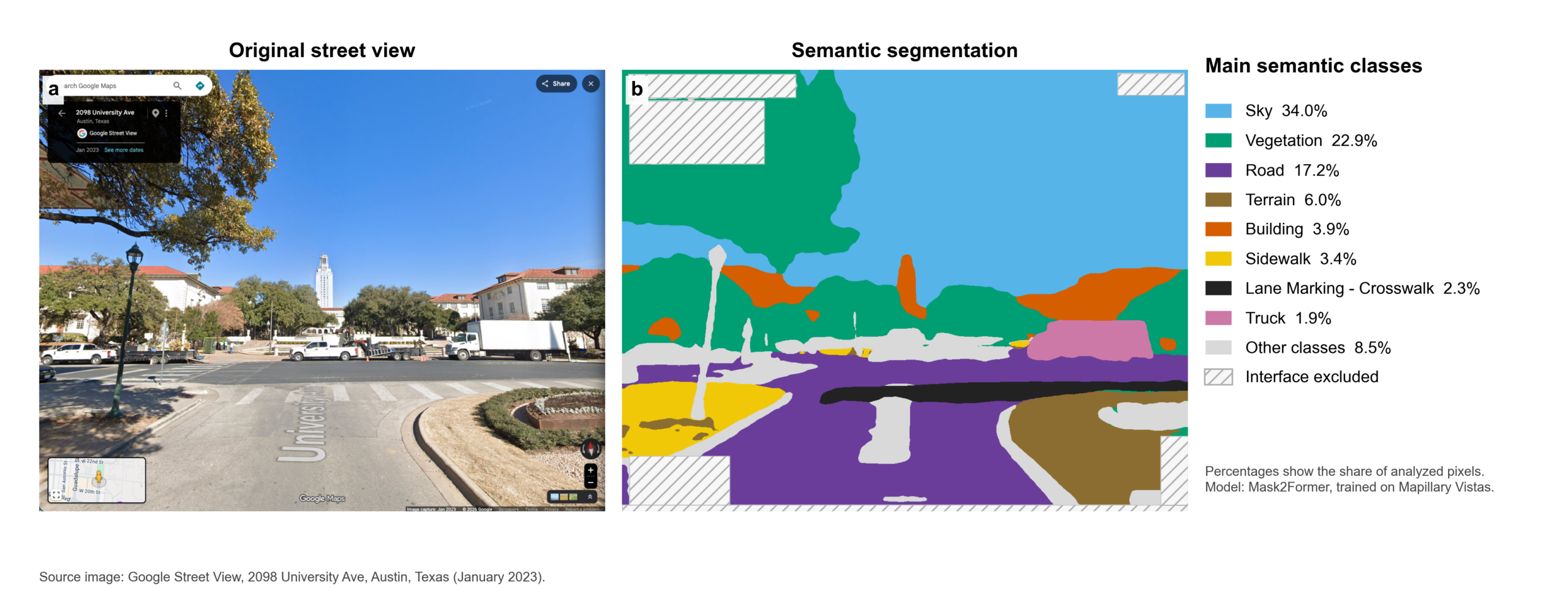
The researchers behind the study used geospatial artificial intelligence (GeoAI) to analyze millions of street view images from four major Texas cities, looking specifically for markers of physical design such as the prevalence of buildings, the presence of certain historical styles, or even the frequency of sidewalks. Researchers then paired those results with detailed, self-reported personality surveys to spot patterns of relationships between the built environment and personality block by block.
The personality surveys used the Big Five personality trait framework, which includes measures of a person’s Openness, Conscientiousness, Extraversion, Agreeableness, and Neuroticism. By using Big Five survey results and linking them to granular neighborhood data, the researchers were able to draw specific connections between an area’s design and the personalities that live in it.
“For the first time, we were able to analyze a dataset of Big Five personality traits alongside computer vision analysis of street-level imagery at this scale,” said co-author Yuhao Kang, assistant professor of geography and the environment at The University of Texas at Austin. “Earlier studies relied on broader units like states or counties. Being able to use fine-scale data at the neighborhood level, where individuals directly experience their environments, with personality data gave us a better understanding of the link between personality and environment.”
Among the researchers’ key findings is that built-environment characteristics were a stronger predictor of openness, the personality trait associated with curiosity and a preference for novelty, than of any other trait in the Big Five. Conscientiousness, meanwhile, was more closely tied to the visual environment. For example, individuals who live in areas with greater visual density, including a higher number of American flags, were associated with lower scores in both conscientiousness and agreeableness.
“Our study identifies associations, but it cannot tell us whether neighborhood environments shape personality, whether people select neighborhoods that fit their personalities, or whether both processes are at work,” Koichi Ito, the leading author at the GISense Lab, carefully noted. Once causal relationships between built-environment features and personality traits are established through future longitudinal research, the authors argue, that evidence could support more targeted urban design strategies such as prioritizing parks and green space if they show evidence of encouraging traits like agreeableness.
“The pattern was surprisingly consistent across many different features of a street at once,” said Sam Gosling, co-author on the study and UT Austin professor of psychology. “And personality shapes so much of life, including long term health, community involvement, even how people handle money, so understanding how it maps onto neighborhoods is functional information.”